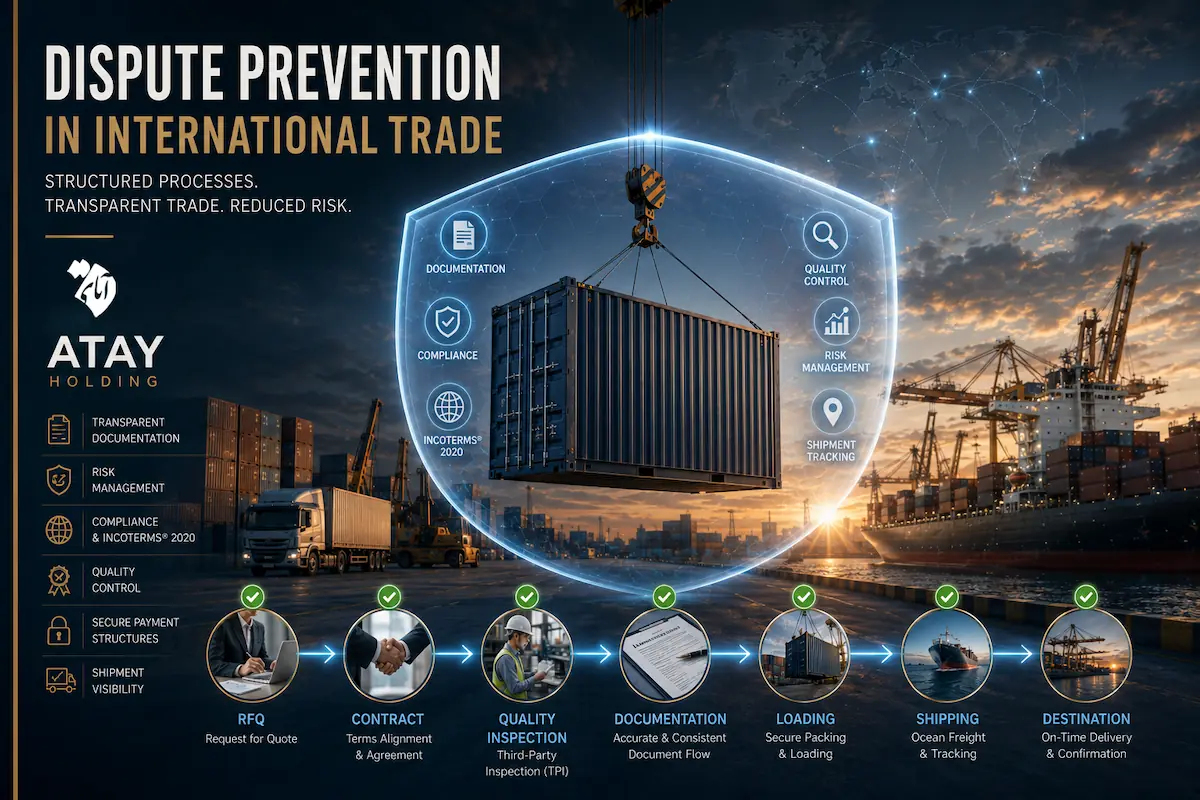
Dispute Prevention in International Construction Materials Trade: How Atay Export Reduces Commercial Risk Through Transparent Structures
1. Introduction: Why Most Commercial Disputes Arise from Misunderstandings, Not Conflict
In the international trade of construction materials—such as cement, clinker, steel, and natural stone—commercial disputes are generally not the result of unprofessional conduct or bad faith. In most cases, these challenges originate from ambiguity, differing interpretations, and incomplete information exchange in the early stages of the transaction.
Common operational challenges include:
- Incomplete or ambiguous technical specifications
- Ill-defined operational responsibilities
- Inconsistencies across commercial and shipping documentation
- Differing interpretations of contractual terms and conditions
Left unaddressed, these issues can later lead to costly operational or financial disputes. In this context, a professional approach to international trade is not limited to dispute resolution; it is primarily focused on dispute prevention through structure, transparency, and precise documentation. Atay Export, the dedicated export division of Atay Holding, applies this principle throughout all stages of cooperation with international clients.
2. Pre-Contract Alignment Meeting
One of the key stages in reducing commercial risk is establishing a shared understanding before finalizing any contract. At Atay Export, a structured alignment stage is conducted between both commercial teams prior to formal contract signing.
During this stage, the following elements are thoroughly reviewed and aligned:
- Product technical specifications and manufacturing grades
- Commercial, financial, and pricing terms
- Shipping and international logistics requirements
- Buyer’s specific destination port and operational expectations
The objective of this stage is to completely eliminate differing interpretations before entering the formal contractual phase, ensuring that the contract is only executed once both parties share a common understanding of all operational details.
3. Precise Definition of Technical Specifications and Quality Tolerances
A significant portion of commercial disputes originates from incomplete product definitions. At Atay Export, technical specifications are fully defined, verified, and documented prior to contract finalization.
These specifications include:
- Dimensions, measurements, and physical specifications
- Product grade and compliance with international standards (e.g., EN, ASTM)
- Chemical and physical properties (where applicable)
- Structural packaging types and handling conditions
- Cargo weight limits and loading methods
- A mutually agreed, acceptable quality tolerance range
In industrial trade, quality is not an absolute, inflexible value; it is defined within an acceptable range. Clarifying this tolerance range plays a critical role in reducing disputes after production and before shipment, and it is directly linked to our quality control processes.
4. Document Lifecycle Management and Version Control
One of the less visible but significant sources of commercial disputes is inconsistency in business documents and the use of non-unified versions among different stakeholders.
The standard documentation chain in an international transaction follows a precise sequence: RFQ (Request for Quote), Quotation, Proforma Invoice, Commercial Invoice, Packing List, Bill of Lading / CMR, and finally the Certificate of Origin.
At Atay Export, this chain is managed as an integrated workflow to ensure absolute data consistency throughout all transaction stages. In addition, a strict Version Control system ensures that:
- Any change in commercial terms is formally and officially recorded.
- Previous or superseded versions are immediately removed from operational use.
- All parties, including manufacturing and logistics, act strictly based on the latest approved version.
5. Separation of Logistics and Financial Risks
A common source of supply chain friction is the lack of clarity in responsibility and cost allocation in international transportation. To address this issue systematically, Atay Export applies two complementary risk frameworks:
Logistics Risk Management via Incoterms® 2020
All commercial contracts are structured based on official Incoterms rules to clearly define:
- Legal responsibility for domestic inland transport versus international freight
- Port handling charges (THC) and terminal operational costs
- The precise geographical point of risk transfer from seller to buyer
- Cargo marine insurance responsibility
Financial Risk Management and Payment Structures
Payment terms are tightly aligned with the physical operational milestones to reduce capital risk exposure for both parties. This includes:
- Documented advance payments
- Staged, milestone-based progressive disbursements
- Final settlement strictly against the presentation of shipping documents or verified Letters of Credit (LC)
6. Operational Transparency and Shipment Visibility
In many high-volume B2B transactions, a significant portion of project tension arises from insufficient or delayed information regarding order status. Accordingly, Atay Export provides milestone-based shipment visibility and structured updates across multiple stages:
- Real-time production status updates
- Packaging, consolidation, and preparation notifications
- Documented loading reports with photographic evidence from terminals
- Shipment departure confirmation and transit documentation release
- Ongoing transit visibility and shipment tracking until arrival at destination (where possible)
This level of transparency completely eliminates uncertainty across the global supply chain.
7. Official Communication Protocol and Change Management
Changes in international supply chains are occasionally inevitable due to market variables, including:
- Fluctuations in global shipping costs
- Unforeseen production or raw material delays
- Logistical, customs, or regulatory constraints
At Atay Export, these adjustments are managed through a defined, transparent Change Management Protocol:
- Prompt Notification: Changes are formally communicated to the client without delay.
- Causal Transparency: A clear, data-backed explanation of the operational variable is provided.
- Formal Records: Documentation and confirmation of changes are officially legally recorded in written addendums.
All official communication is conducted through Official Communication Channels, and only written, authorized, and confirmed communications are considered operationally valid.
8. Expectation Management and Calibration
A major source of soft risk in international procurement is the gap between the parties’ perceptions of material quality and delivery timelines. To minimize this gap, an explicit Expectation Calibration phase is conducted prior to contract execution to ensure that:
- The acceptable quality tolerance range is textually or visually confirmed.
- Production and delivery timelines are realistic and based on actual plant operational capacity.
- Product characteristics are defined purely within the framework of relevant industrial standards.
This process ensures that expectations are grounded in operational realities and prevents unrealistic or unverified assumptions.
9. The Role of Third-Party Inspection (TPI) in Dispute Prevention
Independent Pre-Shipment Inspection (PSI) is an highly effective tool for neutralizing quality-related disputes before cargo leaves the loading terminal.
In this process, an independent entity (such as SGS, Cotecna, or other mutually approved agencies):
- Verifies product quality and metric quantities
- Checks compliance with contractual and technical specifications
- Issues an official inspection certificate to serve as an objective reference
This mechanism ensures that quality assessment is based on a neutral, unbiased reference point, significantly reducing the likelihood of post-delivery disputes.
10. Conclusion
Ultimately, international trade experience proves that the best outcome is achieved when disputes do not arise in the first place. The Atay Export operational methodology is firmly anchored to four core principles:
- Complete transparency in information and documentation flows
- Highly structured, official communication protocols
- Precise and legal definitions of responsibilities, tolerances, and expectations
- Verifiable, traceable processes across the entire international supply chain
By implementing these structural frameworks, Atay Export helps international trade partners mitigate commercial risk, avoid unnecessary operational friction, and focus entirely on scalable procurement and predictable business growth.
Secure a Transparent Supply Chain for Your Next Project
If you are planning to source cement, clinker, steel products, or mineral commodities, structuring your transaction within a transparent framework will directly safeguard your operational margins.
- To submit an official procurement requirement and receive an itemized, transparent commercial evaluation, please visit our Request for Quote (RFQ) page.
- To consult with our trade compliance and risk management specialists regarding contract structuring or payment mechanisms, please contact the Atay International Trade Team directly.
Leave a Reply