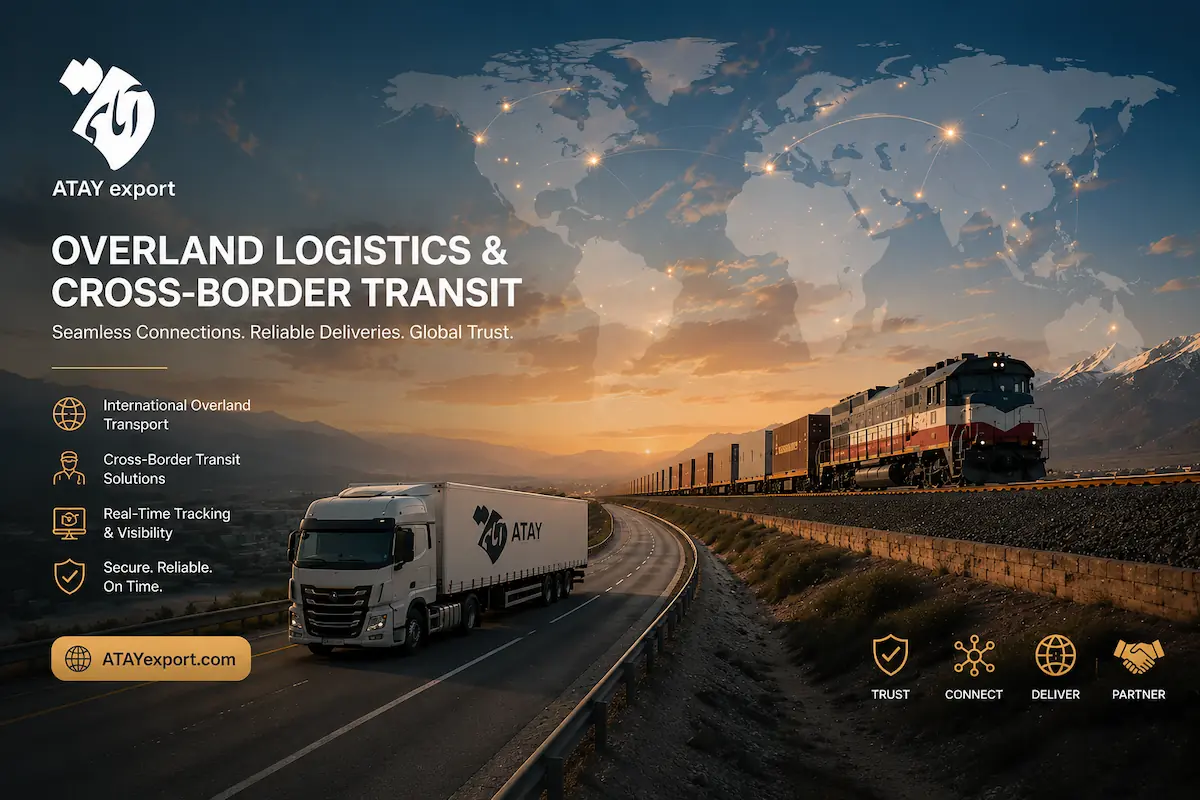
Overland Logistics for Building Materials and Industrial Exports: Managing Road, Rail, and Cross-Border Transit at Atay Export
1. Introduction: Why Overland Logistics Is the Lifeline of Regional Trade
While maritime shipping remains the backbone of global commerce, overland logistics plays a critical role in the movement of building materials, mineral commodities, and industrial products throughout the Middle East, Central Asia, and the Commonwealth of Independent States (CIS).
For many regional markets—including Iraq, the Kurdistan Region, Afghanistan, Turkmenistan, Uzbekistan, Tajikistan, and Kazakhstan—land transportation is not merely an alternative logistics option; in many cases, it serves as the primary transportation corridor for supplying construction materials and industrial products. Even in certain projects involving countries such as Kuwait and Qatar, multimodal transportation solutions combine road and sea freight to connect shipments to regional supply networks.
Compared with ocean freight, overland logistics offers greater flexibility, enables delivery closer to final project locations, reduces intermediate handling stages, and often shortens transit times across regional trade corridors. As a result, route planning, fleet selection, border coordination, and transit documentation management become just as important to the success of an international B2B transaction as the quality of the goods themselves.
At Atay Export, the dedicated export division of Atay Holding, overland logistics is viewed as far more than the physical movement of cargo. It is an integral part of export planning that directly influences project costs, delivery schedules, supply chain reliability, and overall customer satisfaction.
2. Transport Mode Selection and Route Planning
Every export project begins with the development of a logistics strategy tailored to the destination market. Choosing the appropriate transportation method involves much more than selecting the shortest route; it requires evaluating a range of technical, operational, and commercial factors, including:
- Product type and physical characteristics
- Order volume, cargo weight, and dimensions
- Transportation infrastructure and border conditions in the destination country
- Required delivery timeline
- Project logistics budget
For many shipments, road freight is selected because of its speed and operational flexibility. For high-volume and heavy-tonnage cargo, rail freight may provide significant cost advantages. In some cases, multimodal transportation solutions are employed, combining trucks, rail networks, and maritime services to optimize efficiency throughout the supply chain.
At Atay Export, route planning is based on multiple operational factors, including border conditions, fleet availability, seasonal restrictions, transit requirements, project specifications, and the buyer’s delivery expectations. This approach helps identify the most practical and cost-effective logistics solution for each shipment.
3. Road Freight Operations and Fleet Configuration
Road freight remains one of the most widely used transportation methods for exports to regional markets, particularly Iraq, the Kurdistan Region, and Afghanistan. The choice of vehicle depends largely on the nature of the cargo:
Tent Trailers (Curtain-Side Trailers)
For products that are sensitive to rain, dust, or environmental exposure, tent trailers are commonly used. These vehicles are suitable for transporting bagged cement, packaged gypsum, palletized goods, and various industrial products.
Flatbed and Drop-Side Trailers
For heavy-duty cargo such as steel rebars, beams, angles, mineral products, and certain bulk commodities, flatbed and drop-side trailers often provide a more suitable transportation solution.
Axle Load Compliance
In addition to vehicle selection, axle load regulations are a key consideration in international road transport. Maximum axle weights and gross vehicle weight limits vary from one country to another and can significantly affect loading plans and fleet requirements.
For this reason, Atay Export incorporates route-specific legal and operational requirements into transportation planning to help avoid delays, penalties, and compliance issues during transit.
4. Border Management, Cargo Monitoring, and Customs Optimization
Managing border crossings is one of the most critical aspects of international road transportation. Border waiting times may be affected by traffic congestion, customs procedures, regulatory requirements, political developments, or seasonal conditions.
Transloading Operations (Back-to-Back)
On certain trade routes, vehicles from the country of origin may not be permitted to enter the destination country. In such cases, cargo must be transferred from one vehicle to another at border terminals. Because this process can increase the risk of packaging damage and operational delays, proper coordination of loading and unloading activities becomes essential for maintaining cargo integrity.
Demurrage and Detention Risk Management
Extended waiting times at border crossings may generate additional logistics costs, including vehicle detention charges (demurrage) and operational delays. To reduce these risks, transportation documents and customs-related paperwork are prepared and reviewed before cargo reaches the border, helping streamline customs procedures and minimize unnecessary waiting times.
Cargo Visibility and Shipment Tracking
Throughout the transportation process, the Atay Export logistics team maintains continuous communication with carriers, drivers, and logistics partners to provide shipment updates, border clearance status, and Estimated Time of Arrival (ETA) information whenever required.
5. Rail Freight Solutions
For large-volume shipments destined for Central Asia, Russia, and other regional markets, rail freight can provide a competitive and cost-efficient transportation option. Rail transportation is particularly attractive for high-tonnage projects because it can significantly reduce freight costs on a per-ton basis and often serves as a key component of multimodal logistics strategies.
- Covered Wagons: Commonly used for moisture-sensitive or hygroscopic cargo that requires strict protection from environmental exposure, including cement, packaged products, processed minerals, and certain industrial materials.
- Open-Top and High-Sided Wagons: Engineered for commodities such as gypsum rock, clinker, minerals, steel products, and other heavy cargoes where open-top and high-sided wagons provide a more efficient loading and transit solution.
Managing Break of Gauge Operations
One of the technical challenges in rail transportation to CIS countries is the Break of Gauge—the difference in railway track widths between regional networks. Depending on the route, cargo may require bogie exchange operations or physical transloading at rail borders. These activities are incorporated into project planning and scheduling to help ensure efficient cargo movement and proper cargo protection throughout transit.
6. International Transit Documentation
Successful overland logistics depends not only on transportation assets but also on proper documentation management. Several key documents play a critical role in international road and rail transportation:
- CMR (International Road Consignment Note): The primary legal document governing international road transport, recording essential shipment information, including shipper details, consignee information, cargo descriptions, transportation routes, and carrier responsibilities.
- SMGS Railway Consignment Note: The mandatory legal transport document across CIS and Central Asian corridors that supports international rail operations and cross-border coordination.
- TIR Carnet: On eligible transit routes, the TIR system facilitates the movement of customs-sealed cargo across multiple countries while reducing repetitive customs inspections and minimizing border delays.
See Also: For a step-by-step breakdown of how these export documents are integrated into the B2B procurement workflow and verified with buyers, read our comprehensive guide on “From Inquiry to Delivery in Building Materials Export: The B2B Procurement Process with ATAY Holding”.
7. Managing Responsibilities Under Incoterms® 2020
One of the most common mistakes in regional trade is applying maritime Incoterms to overland transportation. Terms such as FOB, CFR, and CIF were developed specifically for sea and inland waterway transport. For road, rail, and multimodal transportation, alternative rules provide greater legal clarity and operational suitability:
- FCA (Free Carrier): Under FCA, the seller delivers export-cleared goods to the carrier nominated by the buyer at an agreed location, such as a factory, warehouse, terminal, or border point.
- CPT (Carriage Paid To): Under CPT, the seller pays transportation costs to the agreed destination. However, the transfer of risk occurs when the goods are handed over to the first carrier, not when they arrive at the final destination.
A clear understanding of these distinctions helps buyers and sellers allocate responsibilities appropriately and make informed insurance decisions.
8. The Connection Between Overland Logistics and Cargo Protection
Successful overland transportation depends not only on route planning and fleet selection but also on packaging quality and cargo protection measures. Road vibrations, border transloading operations, extended waiting periods, and varying environmental conditions can all affect cargo condition during transit. As a result, packaging design and cargo securing methods should be considered integral components of transportation planning.
Related Reading: To learn more about export packaging standards, moisture protection strategies, cargo securing methods, and preserving the integrity of powdered and industrial products throughout international transportation, we invite you to read our article: Preserving Cargo Integrity: International Packaging and Logistics Standards at Atay Export.
9. Conclusion
In regional B2B trade, successful export operations require much more than sourcing quality products. Route selection, fleet management, border coordination, transit documentation, Incoterms compliance, and collaboration among logistics stakeholders all play an important role in ensuring efficient cargo movement.
As the export division of Atay Holding, Atay Export works to develop logistics solutions tailored to the specific requirements of each shipment, destination market, and project scope. From road and rail transportation to multimodal logistics strategies, our objective is to help create more reliable and predictable supply chains for regional trade.
Optimize Your Regional Logistics Strategy
If you are planning to export building materials, mineral commodities, or industrial products to regional markets, selecting the right logistics strategy can have a direct impact on delivery performance, logistics costs, and overall supply chain reliability.
- To initiate an accurate cargo and route budget analysis, please submit a formal inquiry via our Request for Quote (RFQ) page.
- To consult with our transit documentation and cross-border logistics specialists regarding your regional project requirements, please contact the Atay International Logistics Team directly.
Leave a Reply