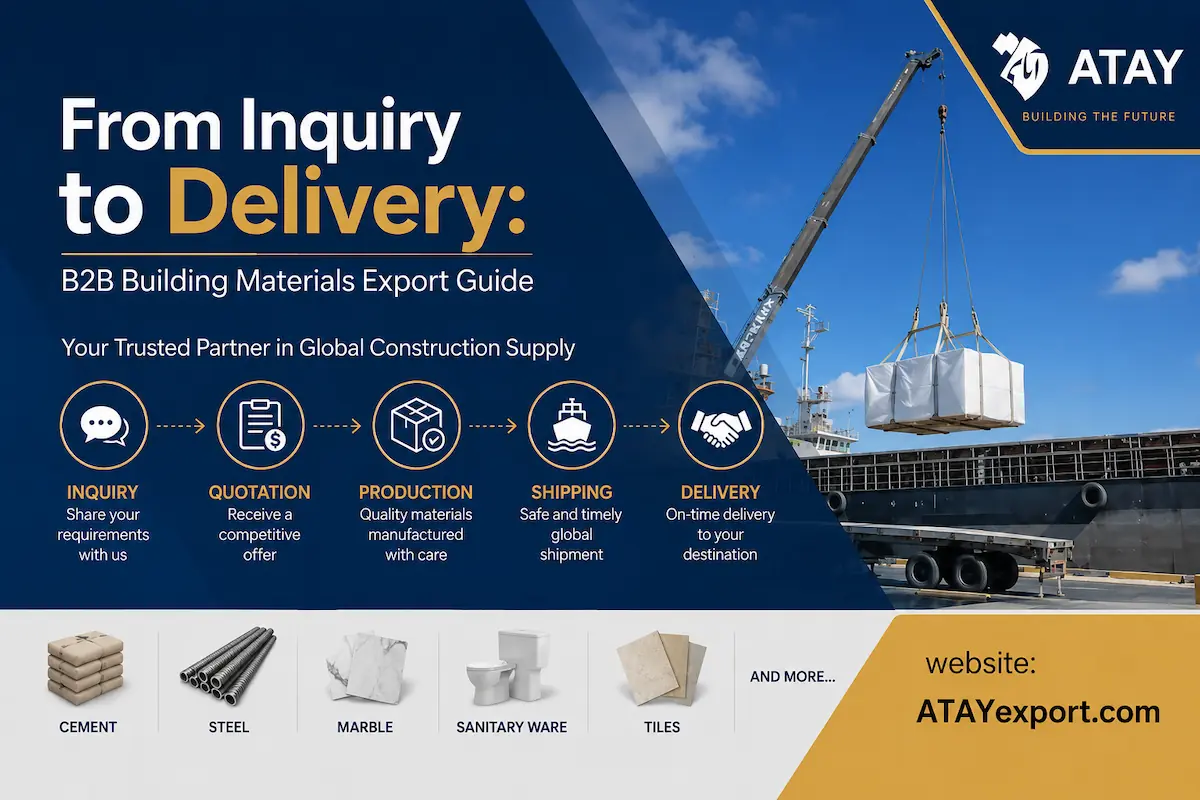
From Inquiry to Delivery in Building Materials Export: The B2B Procurement Process with Atay Holding
1. Introduction: A Structured Process as the Foundation of Secure Large-Scale Trade
In international bulk markets for building materials such as cement, clinker, gypsum, and steel profiles, the success of a transaction depends not only on price, but also on the transparency, stability, and predictability of the supply chain and delivery process. Large-scale importers and civil engineering contractors typically seek partners capable of managing the entire procurement cycle seamlessly—from initial inquiry through to final delivery.
Leveraging a robust network of manufacturers, suppliers, and logistics partners, ATAY Holding has structured the procurement and export of building materials into a transparent, step-by-step process. This guide outlines how customer requests are managed and executed from technical, commercial, quality, and logistics perspectives after submission of an inquiry through the Atay Export platform.
2. Step 1: Request for Quote (RFQ) and Initial Requirement Assessment
The process begins with the submission of a formal Request for Quote (RFQ). At this stage, the objective goes beyond pricing and focuses on assessing supply feasibility while aligning customer requirements with available production capacities.
If you have a specific project requirement, you can submit your formal request through our Request for Quote (RFQ) page to initiate the assessment.
Buyer Verification and Request Review
Initial information regarding the buyer and the nature of the inquiry is reviewed to ensure commercial legitimacy, clarity of requirements, and alignment with regulatory and compliance standards. Where necessary, additional information is requested to refine and complete the evaluation.
Technical and Operational Assessment
The technical specifications of the requested materials are analyzed in detail. For example, in orders involving cement or clinker, parameters such as international standards, grade specifications (e.g., OPC 42.5 or 52.5), required volumes, packaging formats, and delivery schedules are evaluated.
At the same time, production feasibility is assessed against available manufacturing capacity and operational constraints to ensure that the requested timeline can be reliably met.
3. Step 2: Proforma Invoice and Commercial Terms
Upon successful completion of the initial assessment and confirmation of supply feasibility, a formal Proforma Invoice (PI) is issued. This document forms the basis for commercial negotiation, financial planning, and the transition into the execution phase.
Proforma Content
The Proforma Invoice includes key commercial and operational details such as:
- Buyer and seller information
- Detailed product specifications
- Agreed Incoterms (e.g., FOB Bandar Abbas or CFR Jebel Ali)
- Estimated production and loading lead time
Price Validity
Given fluctuations in global commodity and freight markets, quotations are issued with a limited validity period. Depending on the product category, this typically ranges between 4 and 10 days, ensuring timely decision-making and pricing transparency.
Payment Terms
Payment structures are defined based on product type, order volume, and prior cooperation history. These may include partial advance payment with the balance payable upon loading or against shipping documents. For larger projects, the use of Letters of Credit (LC) may also be evaluated and structured accordingly.
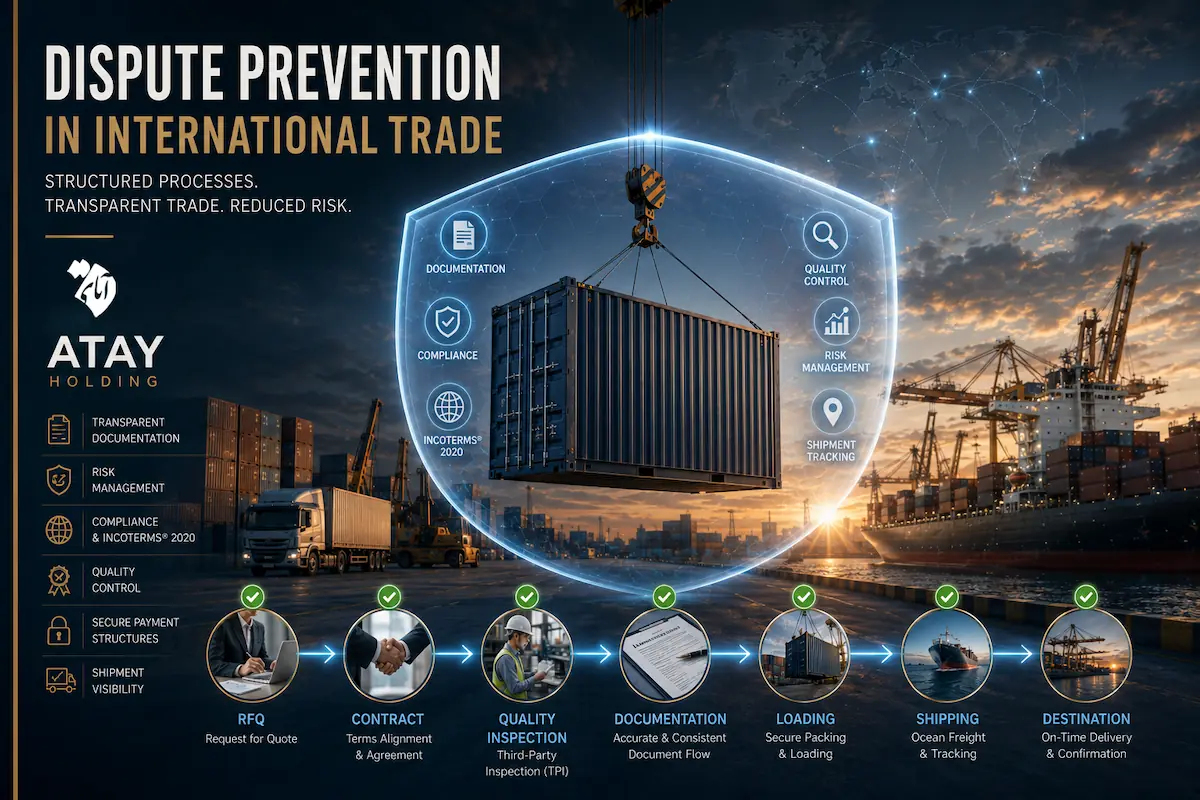
See Also: For more details on aligning financial and logistics milestones, managing commercial risks, and structuring letters of credit to safeguard your trade, visit “Dispute Prevention in International Construction Materials Trade: How Atay Export Reduces Commercial Risk Through Transparent Structures”.
4. Step 3: Quality Control and Technical Compliance
In building materials procurement, strict compliance with agreed technical specifications is essential. Accordingly, quality assurance is implemented across multiple stages of the procurement cycle.
Pre-Contract Phase
Upon buyer request, technical documentation such as Mill Test Certificates (MTCs), chemical and physical analysis reports, or product samples may be provided for preliminary evaluation and compliance verification.
Production and Pre-Shipment Phase
After order confirmation, quality control is continuously conducted by the manufacturer’s internal QA/QC departments. In addition, independent Third-Party Inspection (TPI) services can be arranged at the production site or prior to loading upon buyer request.
This process includes verification of specifications, weight accuracy, packaging integrity, and compliance with contractual requirements. The type of inspection whether Pre-Shipment Inspection, Loading Supervision, or Sampling Inspection is determined based on contractual terms and destination country requirements.
5. Step 4: Logistics Planning and Shipping Execution
International transportation of bulk building materials requires precise logistics coordination to minimize delays, damage risks, and cost inefficiencies.
Transport Mode and Route Optimization
Depending on cargo type and destination, the most appropriate shipping method—containerized, bulk, or land transport—is selected. Route planning is optimized to balance cost efficiency, transit time, and cargo safety.
Packaging and Protection
Appropriate packaging solutions and protective measures are implemented based on product characteristics to mitigate risks such as moisture exposure, contamination, or physical damage, in line with international shipping standards.
Delivery Scheduling
Production, preparation, and shipping timelines are individually defined for each order and clearly documented in commercial agreements. This allows buyers to align procurement timelines with project execution schedules.
6. Step 5: Export Documentation and Customs Clearance
Accurate documentation is a critical requirement for smooth customs clearance in destination markets.
Document Review Process
Once shipping documents are prepared, draft versions are shared with the buyer for verification. This ensures alignment on product details, shipment data, and import requirements prior to final issuance.
Dispatch of Original Documents
Finalized original documents are dispatched either through banking channels (in the case of LC transactions) or via reliable international courier services (for TT/remittance-based transactions). This ensures timely access to all required documentation for customs clearance.
Legalization and Compliance Requirements
Depending on destination country regulations, all necessary certificates—including Certificate of Origin, chamber legalization, and additional export permits—are prepared and coordinated in accordance with compliance requirements.
7. Conclusion: A Structured and Reliable Supply Chain for Global Trade
B2B procurement of building materials is not a simple transactional exchange, but rather a coordinated process involving technical, financial, logistical, and documentary integration.
By leveraging a carefully selected network of manufacturers and suppliers, combined with centralized export management, Atay Holding streamlines the entire procurement journey for international clients. You can learn more about our operational background on our About Us page, or reach out directly via our Contact Us channel to discuss your upcoming project requirements. This structured approach enhances transparency, reduces operational risks, and ensures predictable outcomes—allowing clients to focus on their core construction and development activities.
Leave a Reply